IPTV and OTT are two terms you will see whenever people talk about streaming TV, and they are often used as if they mean the same thing. Both deliver video over internet technology, both can run on your smart TV or phone, and both have replaced a lot of traditional cable and satellite viewing. But they started out as different ideas, and the difference still affects what you watch and how it feels to use.
This guide explains what each term means, compares them on delivery, content, quality, delay, devices and cost, and helps you decide which suits the way you watch.
What is IPTV?
IPTV stands for Internet Protocol Television. In its original sense, it means TV channels delivered over a private, managed network by a broadband or telecom company. The TV box you get from your internet provider is the classic example: the provider controls the whole route from its servers to your home, reserves capacity for the video and can guarantee picture quality.
Today the term is also widely used for subscription services that deliver live channels, catch-up and on-demand content to a player app over a normal internet connection. What these services have in common with classic IPTV is the experience: channel lists, a programme guide and live TV that feels like traditional television. Our plain-English guide to IPTV covers how it works in more detail.
What is OTT?
OTT stands for over-the-top. It describes any video delivered over the open internet, going "over the top" of your broadband connection without the internet provider managing it. Netflix, YouTube, Disney+ and Amazon Prime Video are all OTT services, as are broadcasters’ own streaming apps.
OTT services are usually built around on-demand libraries: you pick a film or episode and press play whenever you like. Many now add some live content too, such as live sport or news, and free ad-supported channel services offer a lineup of always-on channels inside an app.
IPTV vs OTT: the key differences
Here is how the two compare across the things that matter most to viewers.
Delivery
Managed IPTV travels over a private network that the operator controls, so it can be prioritised and protected from congestion. OTT travels over the public internet alongside everything else, so quality depends on your connection and the route between you and the service. Modern OTT services handle this with adaptive streaming, which lowers the picture quality automatically when your connection slows rather than stopping altogether.
Content
IPTV is built around live, linear channels: programmes run to a schedule, and you tune in to what is on. Catch-up and on-demand sections sit alongside. OTT is built around an on-demand library: you choose exactly what to watch and when, and live content is the extra rather than the core.
Programme guide
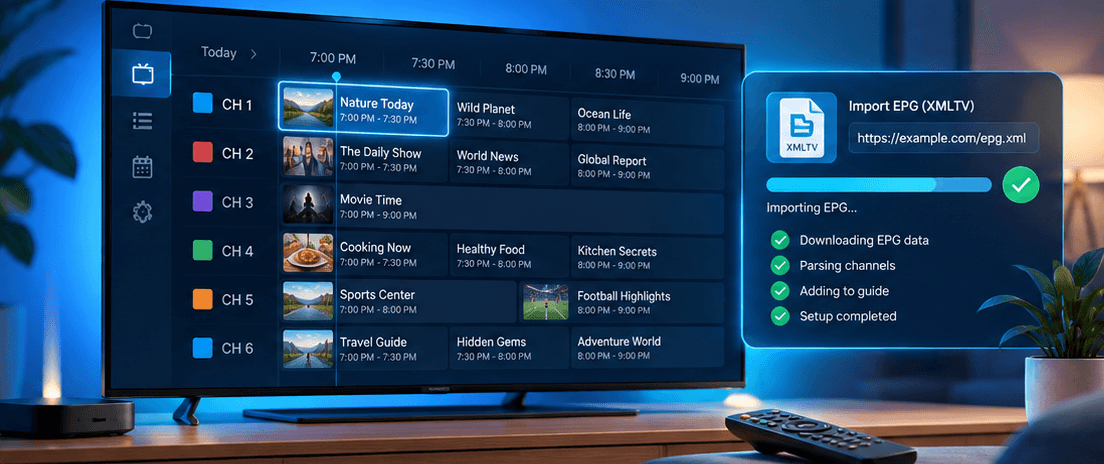
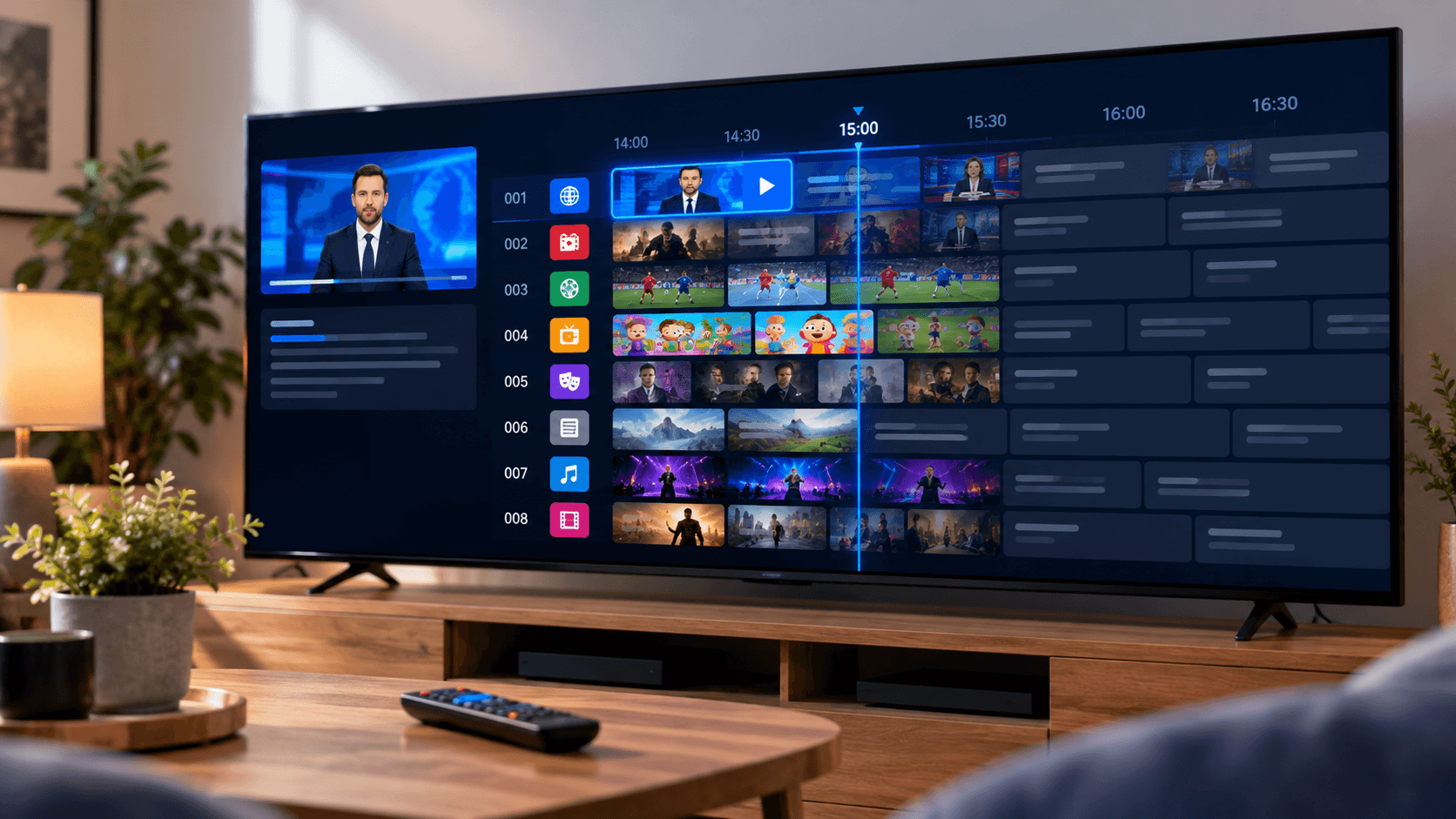
Because IPTV is channel-based, a programme guide is central to it: a grid of channels and times you can browse, just like a TV guide. OTT apps rarely have one. Instead, they use rows of recommendations, categories and search. If you like to browse what is on now, IPTV feels more familiar. Our explainer on what an EPG is in IPTV shows how the guide works.
Picture quality and reliability
Managed IPTV has the edge on consistency, because the operator controls the network. OTT quality varies with your connection, but on good broadband, on-demand OTT services often reach 4K with excellent quality, since films can be prepared and compressed carefully in advance. Live streams, whether IPTV or OTT, are harder to deliver because they must be encoded and sent in real time.
Delay
For live events, delay matters. Managed IPTV typically runs only a few seconds behind the broadcast. Live streams over the public internet usually need a larger buffer to stay smooth, so they can run anywhere from several seconds to around a minute behind. For films and series it makes no difference at all; for live sport it can mean hearing a neighbour cheer before you see the goal.
Devices
Operator IPTV is often tied to the provider’s own set-top box. OTT apps run almost everywhere: smart TVs, streaming sticks, consoles, phones, tablets and browsers. Internet-delivered IPTV services sit in between, working on any device that runs a compatible player app, such as a Fire TV Stick or a Samsung or LG smart TV.
Cost
Operator IPTV is usually sold as part of a broadband or TV bundle, often on a contract. OTT services are typically monthly subscriptions that you can start and cancel easily, though the cost adds up quickly if you subscribe to several. Free, ad-supported OTT options also exist, with a smaller selection of content.
Quick comparison
The main differences at a glance:
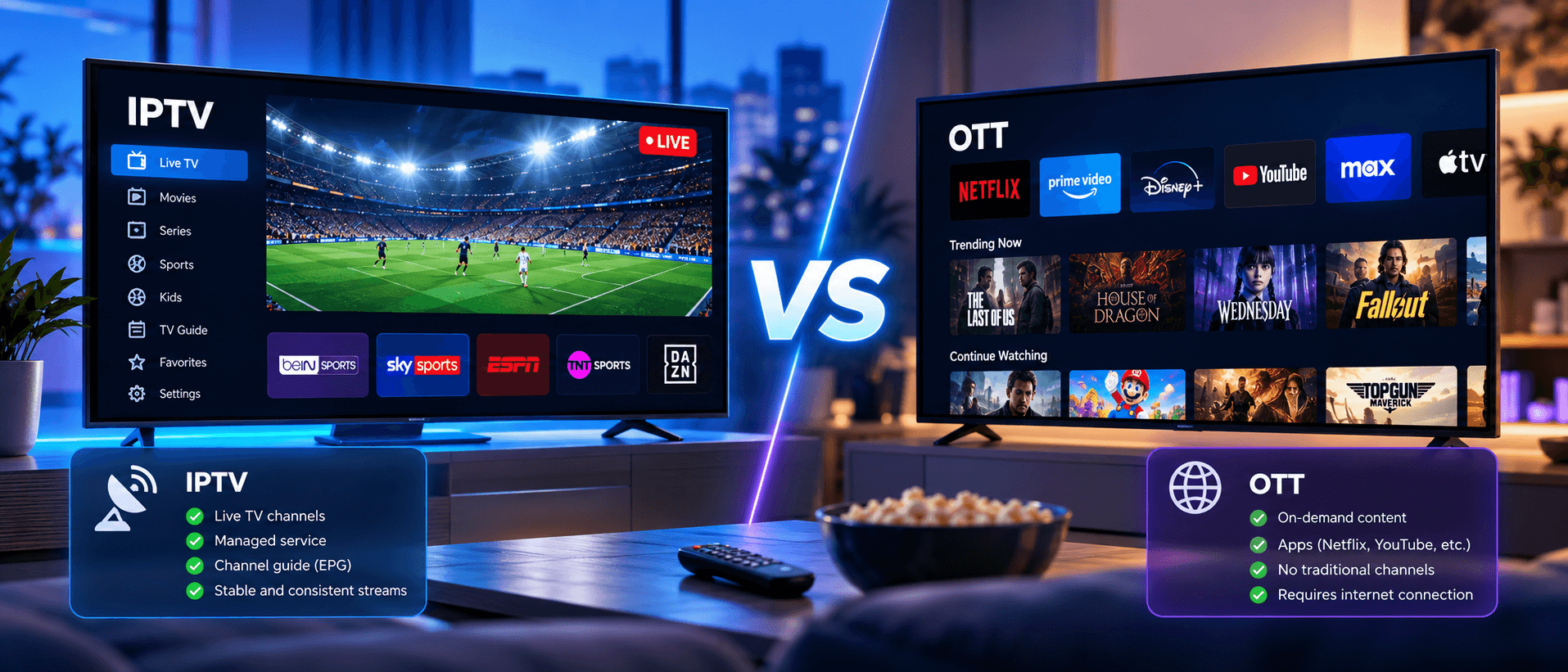
- Network: IPTV uses a managed network (or internet with an IPTV-style app); OTT uses the open internet.
- Viewing style: IPTV is live channels first; OTT is on-demand first.
- Guide: IPTV has a full programme guide; OTT relies on recommendations and search.
- Delay on live events: IPTV is usually lower; OTT is usually higher.
- Devices: IPTV uses a set-top box or player app; OTT has apps on almost every device.
- Pricing: IPTV is often bundled or on plans; OTT is usually a monthly subscription per service.
Where internet IPTV services fit in
Most IPTV subscriptions people sign up for today are, technically, delivered over the top: they use the public internet, not a private operator network. What makes them feel like IPTV is the way you use them: a full channel list, a programme guide, catch-up and live TV, alongside an on-demand library. In other words, they combine OTT’s flexibility with the familiar experience of channel-based TV.
That combination is why delivery quality matters so much. A good service needs well-run servers that hold up on busy evenings, and your home network needs to keep up too. If streams struggle, our guide to fixing IPTV buffering helps you find the cause.
Common myths about IPTV and OTT
A few misunderstandings come up often when people compare the two.
"OTT is always lower quality than IPTV"
Not true. On a good connection, on-demand OTT services regularly stream in 4K with excellent quality. Live content is where managed networks have an advantage, because real-time streams have less time to be prepared and buffered.
"IPTV needs a special box"
Operator IPTV often comes with its own box, but internet-delivered IPTV services run on devices you probably already own: smart TVs, streaming sticks, Android boxes, phones and computers. A dedicated box is optional.
"Faster broadband fixes everything"
Speed helps, but stability matters more. Many homes have plenty of speed on paper and lose it to weak Wi-Fi or busy networks in the evening. A wired connection to the TV often makes a bigger difference than a faster broadband package, for both IPTV and OTT.
"You have to choose one or the other"
Most streaming devices run both, side by side. Plenty of households use an IPTV service for live channels and sport, and one OTT service for the films and series they love, switching between them with the remote.
Which one is right for you?
Your viewing habits decide it more than the technology does.
- Choose IPTV if you mainly watch live channels, follow live sport, like to browse a programme guide or want something that feels like traditional TV.
- Choose OTT if you mostly watch films and series on demand and are happy picking from a recommendation-led app.
- Use both if you want the best of each: many households keep one or two on-demand services alongside a live TV service.
Conclusion
IPTV and OTT both stream TV using internet technology, but they differ in how they are delivered and how they feel to use. IPTV is built around live channels and a programme guide, while OTT is built around on-demand libraries. For most viewers the line has blurred, and the best choice is simply the one that matches how you like to watch.
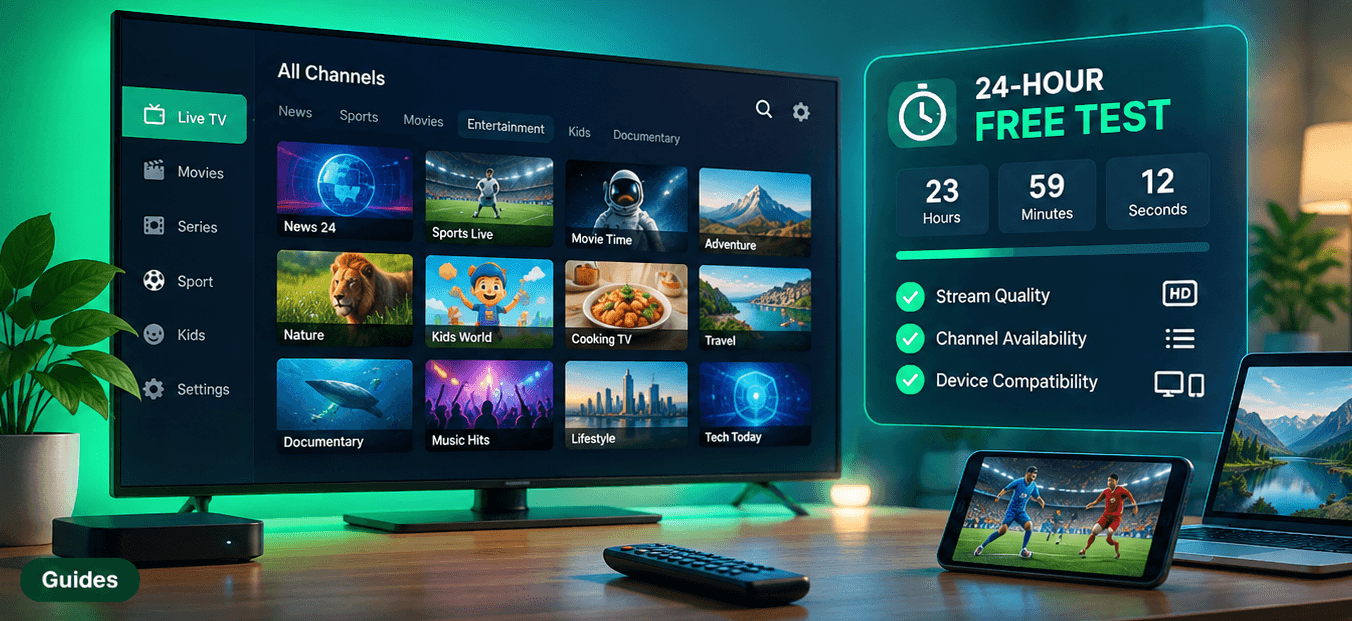
If live channels, sport and a proper TV guide matter to you, request a free trial of REVO IPTV and compare it with your current setup at home, using our 24-hour free test checklist to judge it fairly.
Frequently asked questions
Is Netflix IPTV or OTT?
Netflix is OTT. It delivers on-demand video over the open internet through its own app, without a managed network or a channel-based programme guide.
Is IPTV better than OTT?
Neither is better overall. IPTV suits people who watch live channels and sport, while OTT suits people who mostly watch films and series on demand.
Do IPTV and OTT need the same internet speed?
Roughly, yes. Around 5 Mbps for HD, 8–10 Mbps for Full HD and about 25 Mbps for 4K per stream, plus extra headroom for other devices in the house.
Why is live sport delayed on streaming apps?
Live streams over the public internet use a buffer to stay smooth, which adds delay. Managed IPTV and well-tuned players can reduce it, but some delay is normal on any live stream.
Can I use IPTV and OTT on the same TV?
Yes. Most smart TVs and streaming sticks run both IPTV players and OTT apps, so you can switch between them with the remote.