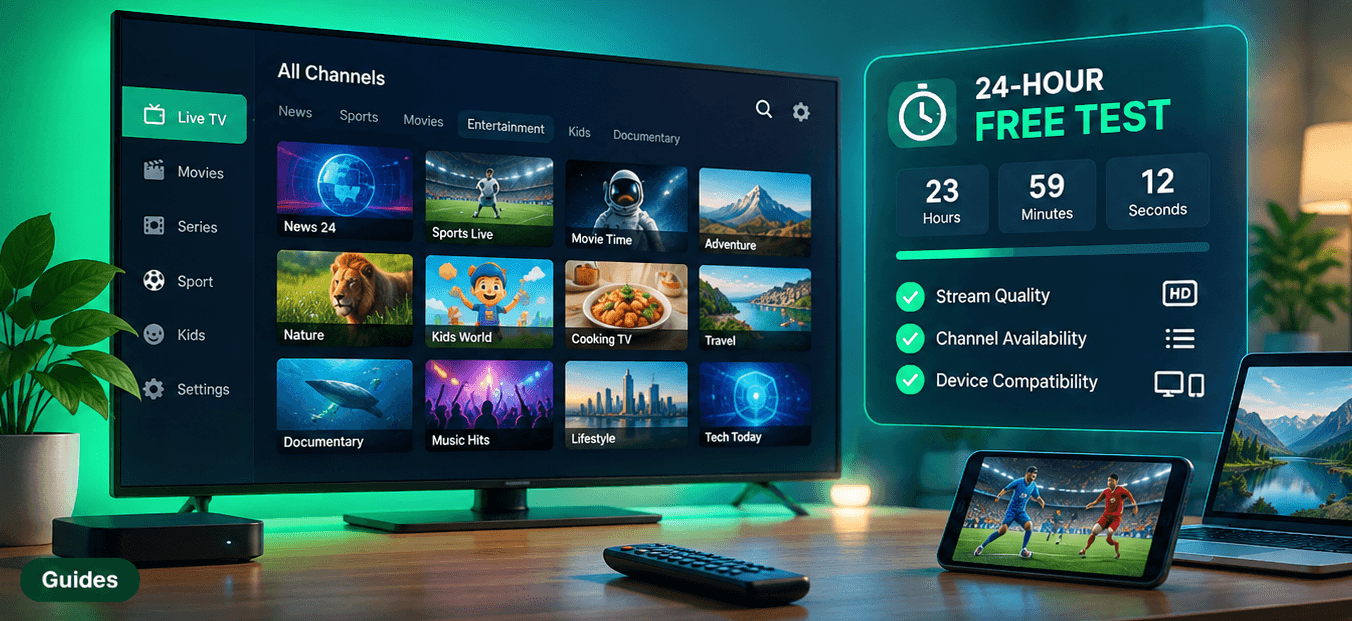
An IPTV free test is the only reliable way to know whether a service will actually work in your home before you spend anything. Every provider promises thousands of channels and zero buffering; a short trial shows you the truth on your own internet connection, your own TV and at the times you really watch. That is exactly why REVO IPTV offers a 24-hour test to new viewers, and why we wrote this checklist to help you use those hours well, whichever provider you end up choosing.
Most people waste their trial. They install an app, flick through a few channels on a quiet Sunday morning, decide it "seems fine" and only discover the problems a week later during a busy Saturday evening match. The plan below splits a 24-hour test into four short sessions, so you see the service under realistic conditions and can make a confident decision.
What an IPTV free test should tell you
Before you start, be clear about what you are trying to learn. A good test answers five questions:
- Stability: do live channels play for long stretches without freezing, especially at peak times?
- Picture quality: are HD, Full HD and 4K streams genuinely sharp on your screen, not just labelled that way?
- Content: are the specific channels, leagues and shows you watch actually included and working?
- Usability: is the TV guide accurate, is switching channels quick and does the app suit your device?
- Support: how quickly and helpfully does the provider answer when you ask a question?
Everything else, from the size of the channel count to slick branding, matters far less than these five. Keep them in mind and you will avoid being swayed by numbers that do not affect your evenings.
Before the trial: 10 minutes of preparation
A few minutes of setup makes your results far more trustworthy, and it means you spend the trial testing rather than troubleshooting.
Check your internet speed first
Run a speed test on the device you will watch on, not on your phone, using a site such as fast.com or Speedtest. As a rough guide, HD streams need around 5 Mbps, Full HD around 8–10 Mbps and 4K roughly 25 Mbps per screen. If your connection falls below these figures, poor quality during the test may be your network rather than the service, and it is worth knowing that before you judge anyone.
Write down the channels you actually watch
Make a short list of ten to fifteen channels and programmes that matter to you: your local news, the league you follow, the cartoon channel your children ask for. During the test you will check each one. Browsing the channel categories in advance helps you spot what to look for and saves time once the trial clock is running.
Choose your device and app
Test on the screen you will use most. If that is a Fire TV Stick, follow a proper Fire Stick setup guide so a misconfigured app does not skew your results. On Samsung or LG televisions, pick a well-reviewed player from our roundup of Smart TV player apps. A good app will not rescue a poor service, but a bad app can make a good service look unreliable.
The 24-hour test plan
Spread your testing across the day. Four sessions of 20 to 30 minutes each give a far more accurate picture than one long session, because they capture the quiet hours and the busy ones.
Session 1: Setup and first impressions (any time)
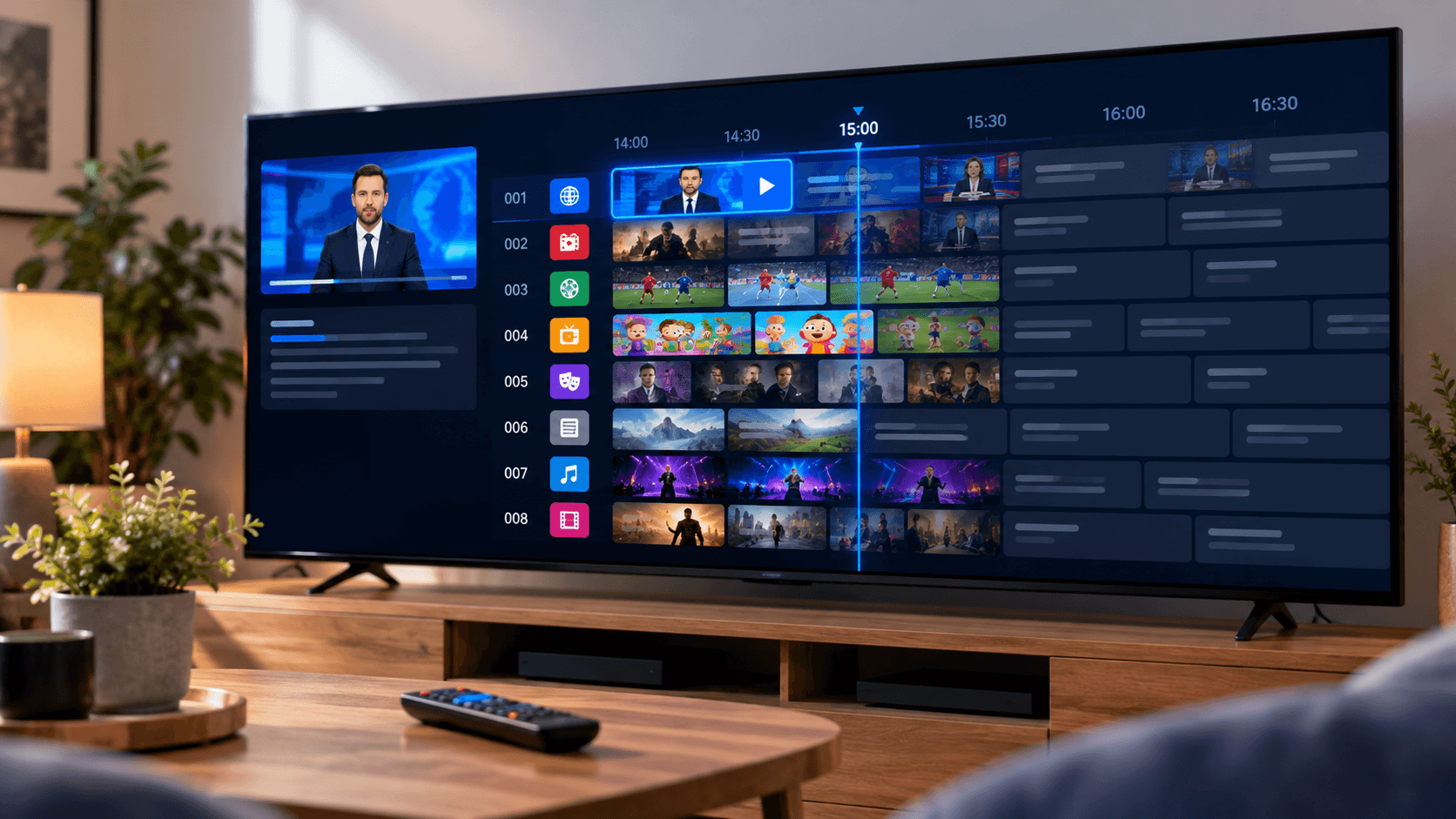
Note how long activation takes and how clear the setup instructions are. Once logged in, check that the channel list loads fully, that categories are organised sensibly and that the programme guide fills in. If the guide stays empty, ask support for the correct guide link; our explainer on how an IPTV EPG works covers what to expect and why it matters.
Session 2: Picture quality check (daytime)
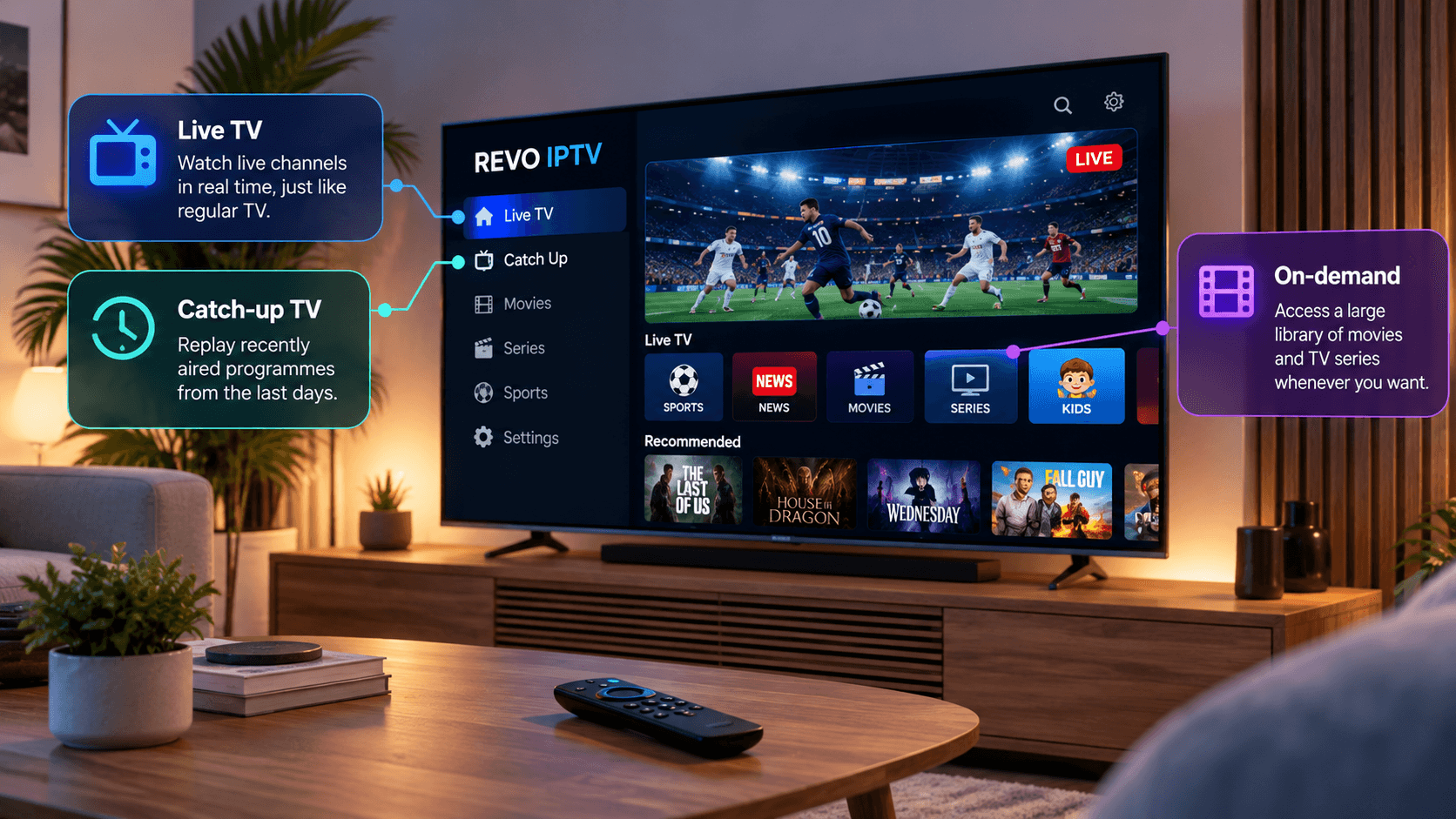
Pick three channels you know well and watch each for five minutes. Look for blocky artefacts during fast motion, washed-out colours and audio drifting out of sync with the picture. Then open a 4K or Full HD channel and compare it with an HD version: on a large television the difference should be obvious. Try a couple of films from the on-demand library too, since video on demand is often delivered from different servers than live TV.
Session 3: Peak-time stress test (7–10 pm)
This is the most important session of the whole test. Evenings are when home networks, internet providers and streaming servers are all at their busiest, so problems that never appear at midday show up now. Watch a live event or a popular sports channel for at least 20 minutes and count the freezes.
One brief pause in 20 minutes is acceptable; repeated buffering every few minutes is a red flag. If you do see buffering, run through our IPTV buffering troubleshooting guide to rule out your own Wi-Fi before blaming the provider. It is surprisingly common for a weak wireless signal to be the real culprit.
Session 4: Features and support (next morning)
Use catch-up or replay on a programme from yesterday, try the search function, add a few favourites and test switching between channels quickly. Finally, send support a genuine question, for example which app they recommend for your television, and time the reply. A fast, clear answer during a trial is a good indication of how you will be treated as a paying customer.
How to score your results
Keep the scoring simple. Rate each area from 1 to 5 and add one sentence of notes, so you can compare services later without relying on memory:
- Stability at peak time
- Picture quality on your main screen
- Coverage of your must-have channels
- Guide accuracy and overall app experience
- Support speed and helpfulness
A service that scores 4 or 5 on stability and channel coverage is usually worth paying for, even if the app takes a little getting used to. Low stability scores, on the other hand, are rarely fixed by a longer subscription, so do not let a discount on a 12-month plan talk you out of what you saw.
Red flags to watch for during a trial
Some problems are minor annoyances. Others suggest the service will disappoint you over time. Take note if you see any of the following:
- Large numbers of dead or duplicate channels in the categories you care about.
- Frequent buffering at peak time even on a wired connection with good speeds.
- A programme guide that is empty, hours out of sync or missing for most channels.
- No clear refund policy, terms of service or contact details anywhere on the website.
- Pressure to pay for a long plan before the trial has finished.
- Support that goes quiet as soon as you ask a technical question.
Any single item deserves a direct question to the provider. Two or more is a good reason to keep looking.
Making a fair comparison between providers
If you are testing more than one service, run the same checklist at the same times of day, on the same device and the same connection. Otherwise you end up comparing your Wi-Fi on a quiet Tuesday with your Wi-Fi during a Saturday derby, which tells you nothing useful.
Check how many screens each plan allows at once as well. If two people in your home watch at the same time, read how multiple connections work so your test reflects real use rather than a single viewer on a single screen.
Price comparisons become much easier once quality is settled. Divide each plan price by its number of months to get a true monthly cost, then check exactly what is included. Our subscription plans page shows the monthly figure for every duration, so you can compare like for like.
After the test: what to do next
If the service passed, choose a plan length that matches your confidence. Shorter plans cost a little more per month but keep you flexible; longer plans offer better value once you are sure. Ask whether your trial login can be converted into a paid account, so you keep your favourites and app settings.
If it failed, tell the provider exactly what went wrong. Sometimes a different server or player fixes the issue straight away, and a good provider will offer to extend the test. If not, move on. That is precisely what a free test is for.
Conclusion
A free test is only as useful as the effort you put into it. Prepare your channel list, test at peak time, score the results honestly and ask support at least one real question. Do that and you will know within a day whether a service deserves your money. Ready to put this checklist to work? Start your 24-hour free trial and see how REVO IPTV performs on your own screen.
Frequently asked questions
How long should an IPTV free test last?
Twenty-four hours is enough if you test at different times of day, including at least one evening session. Longer trials are useful but not essential; what matters most is testing at peak time.
Do I need a credit card for a free IPTV test?
Not usually. Reputable providers, including REVO IPTV, can activate a trial with just your contact details. Be cautious of any free test that asks for card details and quietly renews into a paid plan.
Why does my trial buffer when my internet is fast?
Speed is only part of the picture. Wi-Fi interference, an overloaded streaming stick, slow DNS or throttling by your internet provider can all cause buffering on a fast connection. Testing on Ethernet is the quickest way to find out whether the problem is local.
Can I test on more than one device?
Yes, but trials usually allow one connection at a time. Test devices one after another rather than simultaneously, or ask the provider for a multi-connection trial if your household watches on several screens.